 By Michael Thompson
Our Editorial Research & Methodology
The State of the Smart Home in 2026
By now, we were supposed to have flying cars. We don't. But what we do have are homes that finally talk to each other without throwing a digital tantrum. In 2026, the 'Smart Home' isn't just a collection of gadgets; it is an ecosystem. At the center of that ecosystem sits the thermostat.
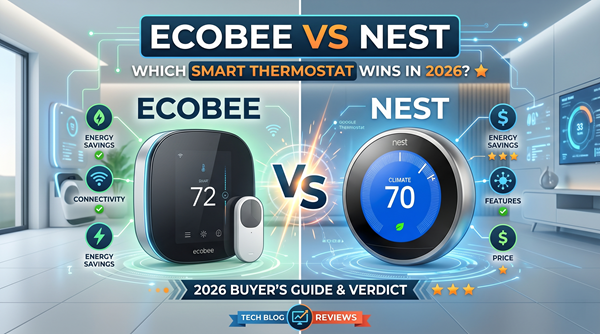
The battle between Ecobee and Nest has shifted. It is no longer just about who has the prettiest dial or the best app. It is about Matter 2.0, predictive AI, and how well these devices can manage your skyrocketing energy costs. If you are standing in an aisle or scrolling through a tab trying to decide between these two giants, you are looking for more than a temperature regulator. You are looking for a house manager.
Here is the thing: both brands have matured. The 'bugs' of the early 2020s are gone. What remains are two very different philosophies on how a home should feel. Let's get into the weeds and see which one actually deserves a spot on your wall.
The Philosophy: Learning vs. Sensing
The fundamental difference between Nest and Ecobee has always been their 'brain.' Nest, owned by Google, bets everything on AI learning. It wants to watch you. It learns when you wake up, when you leave for work, and how low you like the temp when you're binging Netflix. After a week, it thinks it knows you better than you know yourself.
🏆 Our Top Picks
Ecobee Smart Thermostat Premium
The gold standard for control freaks. It includes a built-in air quality monitor, a high-quality speaker for Siri/Alexa, and the most accurate remote sensors on the market. Best for larger homes with uneven cooling.
Check Price on Amazon →Google Nest Learning Thermostat (4th Gen)
A stunning piece of hardware that uses AI to build a schedule around your life. The borderless glass display is the best in the industry. Best for users who want a 'set it and forget it' experience.
Check Price on Amazon →Ecobee Smart Thermostat Enhanced
A streamlined version of the Premium model that keeps the core 'Eco+' energy-saving features but skips the air quality sensor and built-in speaker. Best for those who want Ecobee's reliability on a budget.
Check Price on Amazon →Google Nest Thermostat (2020 Model)
The entry-level Nest that uses a mirrored display and touch-sensitive strip. It doesn't 'learn' your habits like the higher-end model, but it offers the core Google Home experience for a fraction of the price.
Check Price on Amazon →Ecobee SmartSensor (2-pack)
Essential add-ons for any Ecobee system. These sensors track both motion and temperature, allowing the thermostat to focus energy only on the rooms you are currently using.
Check Price on Amazon →Ecobee takes a more literal approach. It relies on remote sensors. Instead of guessing where you are based on your phone's location or a single sensor in the hallway, Ecobee puts 'eyes' in every room. It does not care as much about your habits as it does about the actual temperature in the bedroom where you are actually sleeping.
Why this matters in 2026
With the 2026 updates to Google's Gemini-powered scheduling, Nest has become eerily accurate. It can now predict 'pre-cooling' needs based on local grid strain and weather patterns better than ever. However, Ecobee’s latest SmartSensor 3rd Gen has reduced latency to near zero. If you walk into your home office, the HVAC kicks on before you even sit in your chair. Nest is about the schedule; Ecobee is about the space.
Design and Hardware: Jewelry vs. Tech
Nest has always been the 'Apple' of thermostats. The 4th Generation Nest Learning Thermostat is a piece of industrial art. It features a borderless glass display and a stainless steel ring that feels like a high-end watch. When you turn it, there is a weighted click that feels expensive. It is designed to be a focal point.
Ecobee, specifically the Smart Thermostat Premium, looks like a very nice piece of consumer electronics. It is a glass-fronted black squircle. It is clean, modern, and unobtrusive. While Nest wants you to look at it, Ecobee wants to disappear into your wall.
| Feature | Google Nest (4th Gen) | Ecobee Premium |
|---|---|---|
| Build Material | Stainless Steel & Glass | Zinc & Glass |
| Display Type | Dynamic Farsight (LCD) | Vivid Touchscreen |
| Remote Sensors | Optional (1 included) | Included (1-2 depending on bundle) |
| Air Quality Monitor | No | Yes (Built-in) |
One major hardware win for Ecobee is the built-in Air Quality Monitor. In 2026, with indoor air quality becoming a massive health focus, having your thermostat tell you when VOCs (Volatile Organic Compounds) are high or when you need to open a window is a huge plus. Nest still requires a separate Nest Protect or third-party sensor for this level of detail.
The Matter 2.0 Revolution
If you bought a smart device three years ago, you probably dealt with the 'walled garden' problem. Nest worked best with Google; Ecobee was the darling of HomeKit users. In 2026, Matter 2.0 has leveled the playing field. Both devices now play perfectly with Apple Home, Amazon Alexa, Google Home, and Samsung SmartThings.
What most people miss is that while both support Matter, the depth of integration varies. Ecobee still feels like a native Apple HomeKit device. Its response time when using Siri is instantaneous. Nest, even with Matter, still feels slightly more 'at home' within the Google Home app. If you are a hardcore 'Hey Google' household, the Nest integration with Google Home’s 'Automation Engine' is hard to beat. It can trigger your lights and security system the moment the thermostat switches to 'Away' mode with zero lag.
Energy Savings: The Bottom Line
Let's talk money. Both companies claim they save you about 20% to 25% on heating and cooling. In my experience, those numbers are 'best-case scenarios.' However, in 2026, energy companies are pushing Time-of-Use (TOU) rates harder than ever. This is where the thermostats earn their keep.
Nest uses 'Renewable Link,' which prioritizes running your AC when the grid is using cleaner energy or when prices are lower. It is incredibly passive. You just see a little leaf icon and know you're saving money.
Ecobee’s 'Eco+' suite is more aggressive. It looks at the humidity levels (which it measures better than Nest) and realizes that 72 degrees at 30% humidity feels the same as 68 degrees at 60% humidity. It adjusts the 'feel' of the home rather than just the raw number on the screen. This 'Thermal Comfort' algorithm is, frankly, smarter than Nest’s basic learning path for most humid climates.
Installation: The C-Wire Headache
If you live in an older home, you might not have a 'C-wire' (common wire) to provide constant power. Nest has long claimed they don't need one, using 'power sharing' to trickle charge. In reality, this often leads to 'pulsing' in your HVAC system or the thermostat dying in the middle of a cold snap.
Ecobee is honest about it. They include a Power Extender Kit (PEK) in the box. It takes 15 minutes to install at your furnace control board, and it solves the power issue forever. Nest has improved their internal battery in the 4th Gen, but for 2026, I still recommend a C-wire or the Ecobee PEK for total reliability. Don't risk your HVAC's motherboard on 'power sharing' tricks.
Hidden Costs and Subscriptions
This is the part everyone hates. Both brands have moved toward 'Service Models.'
- Nest: To get the most out of the ecosystem, you usually want Nest Aware. This is mostly for cameras, but it ties into the thermostat's ability to detect smoke alarms or glass breaking.
- Ecobee: They offer 'Ecobee Smart Security.' It uses the thermostat’s built-in sensors (and the remote sensors) as a DIY security system. It can even detect the sound of a smoke alarm and alert your phone.
If you just want a thermostat, you don't need these. But Ecobee’s security features feel more integrated into the hardware you already bought. Nest feels like it's constantly trying to upsell you on the broader Google subscription cloud.
Which One Should You Buy?
After testing both in real-world 2026 conditions, here is the breakdown.
Choose the Google Nest Learning Thermostat if: You want the most beautiful object on your wall. You want a device that learns your life so you never have to touch it. You are already deep in the Google/Android ecosystem and want that seamless Gemini AI integration.
Choose the Ecobee Smart Thermostat Premium if: You have 'hot spots' or 'cold spots' in your house. You care about air quality monitoring. You use Apple HomeKit. You want more granular control and data. In my experience, Ecobee is the 'power user' choice, while Nest is the 'luxury' choice.
In 2026, you really can't go wrong with either. The 'Smart Home' has finally grown up. Just make sure you check your wiring before you start unscrewing your old Honeywell.
Frequently Asked Questions
Does Ecobee work with Google Home?
Yes, through the Matter 2.0 protocol, Ecobee integrates seamlessly with Google Home, allowing for voice control and inclusion in Google Home routines.
Can Nest work without a C-wire in 2026?
While the 4th Gen Nest has improved power management, a C-wire or a Nest Power Connector is still highly recommended to prevent system 'pulsing' or battery drain during extreme weather.
Which thermostat is better for multi-story homes?
Ecobee is generally better for multi-story homes because its remote sensors are more effective at averaging temperatures across different floors to eliminate hot and cold spots.