 By Michael Thompson
Our Editorial Research & Methodology
The Sweet Spot of Home Automation
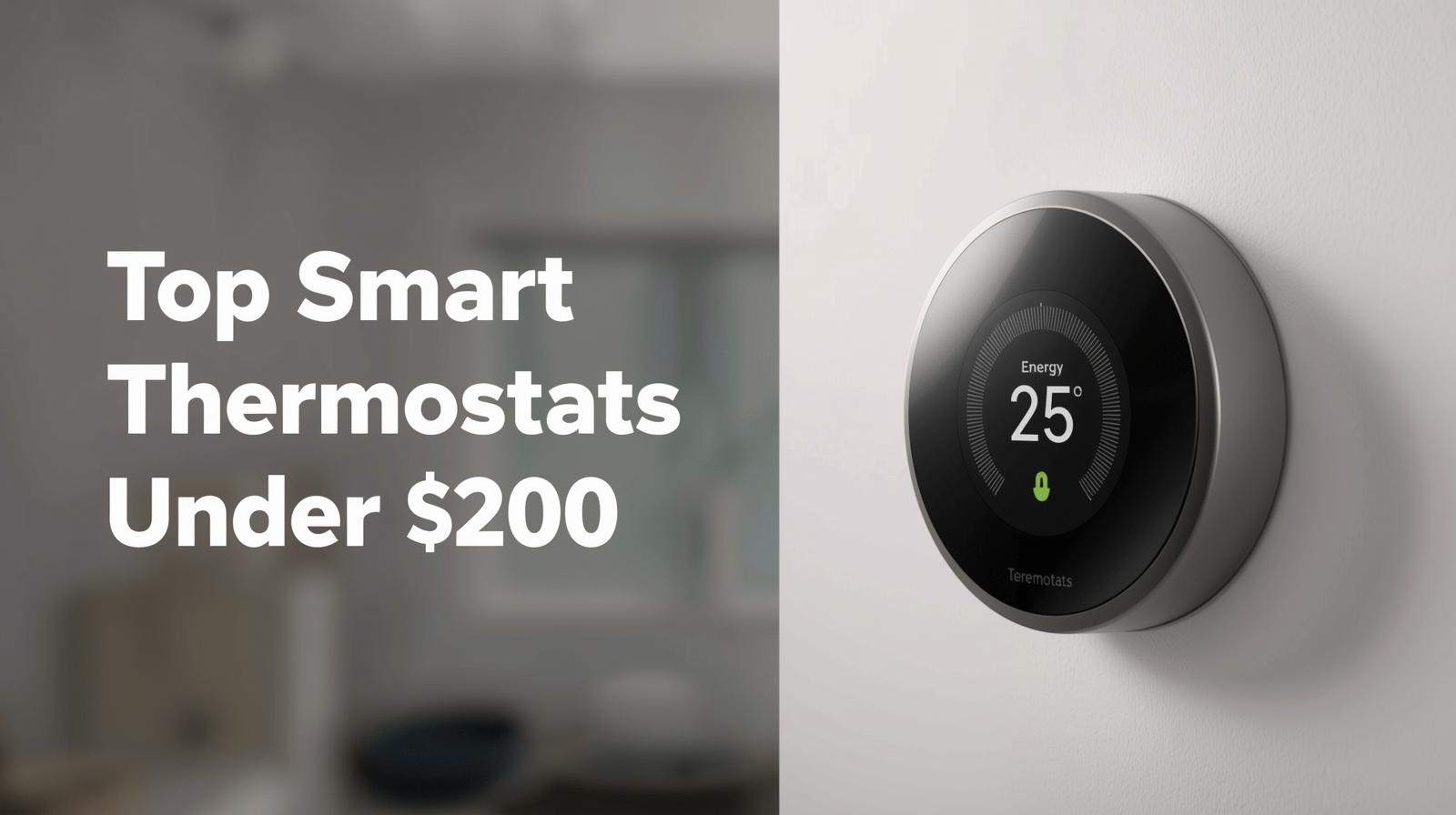
Stop overpaying for features you will never use. For years, the smart home industry tried to convince us that a thermostat needed to be a $350 piece of art or a secondary smart speaker. In 2026, that narrative has finally crumbled. You can now get a world-class, energy-saving, Matter-enabled device for well under $200.
Here is the thing: the core technology that saves you money on your electric bill is no longer exclusive to the high-end models. Whether you want a device that learns your habits or one that you can simply control from your phone while lying in bed, the sub-$200 market is where the real value lives. I have spent years testing these gadgets, and I can tell you that the gap between a $150 unit and a $350 unit has never been smaller.
Why $200 is the Magic Number
At this price point, you are no longer buying a 'budget' compromise. You are buying a mature product. Most devices in this range now include high-resolution displays, compatibility with every major smart home ecosystem (Apple Home, Google Home, Alexa), and the sensors needed to actually make a difference in your comfort. You are skipping the 'luxury' tax of premium materials like stainless steel or built-in high-fidelity speakers, which, let's be honest, nobody uses on a thermostat anyway.
The Matter Revolution in 2026
If you are buying a thermostat today, you must look for Matter support. Matter is the universal language that allows smart devices from different brands to talk to each other locally without needing the cloud. In the past, you had to worry if a Nest would work with your Apple setup. Now, thanks to Matter 1.4 and beyond, that headache is mostly gone.
🏆 Our Top Picks
Ecobee Smart Thermostat Enhanced
This model features advanced radar occupancy sensing and a crisp touch display. It is the best all-rounder for those who want professional-grade features like HVAC health monitoring and seamless Apple Home integration without the $250+ price tag.
Check Price on Amazon →Google Nest Thermostat (2020/2025 Model)
Known for its iconic aesthetic and simple interface, this Nest model uses Soli technology for motion sensing. It is perfect for users who want a 'set it and forget it' experience with the best mobile app in the business.
Check Price on Amazon →Honeywell Home T9 Smart Thermostat
The T9 is the king of multi-room comfort. It excels at managing uneven temperatures in large homes by using remote sensors to prioritize specific rooms, ensuring your bedroom is cool even if the living room is empty.
Check Price on Amazon →Amazon Smart Thermostat
Built in partnership with Honeywell, this is the ultimate budget pick. It lacks a fancy screen but offers top-tier energy savings and Alexa integration for a fraction of the cost of other brands.
Check Price on Amazon →Every recommendation on this list has been vetted for its ability to play nice with others. This means faster response times and better privacy. When you adjust the temperature on your phone, it happens instantly. No more waiting for a signal to bounce to a server in another state and back to your living room.
Top Smart Thermostats Under $200 Compared
| Model | Best For | Matter Support | Remote Sensors |
|---|---|---|---|
| Ecobee Enhanced | Overall Performance | Yes | Compatible |
| Google Nest (2025) | Design Lovers | Yes | No |
| Honeywell Home T9 | Large Homes | Yes | Included |
| Amazon Smart | Extreme Value | Yes | No |
1. Ecobee Smart Thermostat Enhanced
The Ecobee Enhanced is arguably the smartest pick for most people. It sits right at the edge of the $200 limit, but it offers the most robust feature set. What most people miss is that Ecobee uses a radar-based occupancy sensor. Unlike older infrared sensors that need to 'see' you, radar can detect movement through walls or around corners. This means it knows you are home even if you are just sitting on the couch reading.
The interface is snappy, and the integration with Apple Home is flawless. If you have a room that is always colder than the rest of the house, you can add an Ecobee SmartSensor to that room. The thermostat will then prioritize that room's temperature during the night. It is a game-changer for sleep quality.
2. Google Nest Thermostat (Latest Generation)
Google simplified their lineup recently, and the result is a sleek, mirror-finished device that looks like it belongs in a high-end gallery. It uses a Soli sensor—the same tech found in high-end smartphones—to detect when you walk by. It does not have a rotating dial like the expensive 'Learning' model, but the touch-sensitive side strip is intuitive and less prone to mechanical failure.
In my experience, the Nest app remains the gold standard for ease of use. It provides a 'Leaf' icon when you choose a temperature that saves energy. It sounds simple, but that little bit of gamification actually changes how people use their HVAC systems. One downside? It is not as friendly with remote sensors as the Ecobee or Honeywell models.
3. Honeywell Home T9
Honeywell has been making thermostats since your grandparents were kids, and that experience shows in the T9. It is not the prettiest device on the list, but it is a workhorse. The T9 is specifically designed for people with 'hot spots' or 'cold spots' in their homes. It often comes bundled with a remote sensor for under $180.
The T9 focuses on 'Multi-room Focus.' You can tell the system to ignore the hallway temperature and focus entirely on the nursery or the home office. For anyone working from home in 2026, this is the feature that actually matters. It prevents the AC from running unnecessarily just because the hallway is a bit warm while you are shivering in your office.
The C-Wire: What You Need to Know
Before you buy, you need to check your furnace. Most smart thermostats require a 'C-wire' (Common wire) for constant power. If you pull off your old thermostat and see a blue or black wire that is not connected, you are likely in luck. If you only see two wires, do not panic. Most modern kits under $200, especially the Ecobee, include a Power Extender Kit (PEK).
Installation usually takes about 20 minutes. You do not need an electrician. You just need a screwdriver and the ability to read a label. If your home was built after 1990, you almost certainly have the wiring needed for any of these devices.
Features That Actually Save Money
Do not get distracted by fancy color screens. The real savings come from three specific features: Geofencing, AI Scheduling, and HVAC Monitoring. Geofencing uses your phone's GPS to know when you have left the house. It automatically kicks the system into 'Eco' mode. This is far more effective than a static schedule because life is unpredictable.
HVAC Monitoring is the hidden gem of 2026 tech. These thermostats can now detect if your AC is taking too long to cool the house. They will send you an alert saying, 'Hey, your system is struggling. You might want to check your filter or call a pro before it breaks.' That one alert can save you thousands in emergency repair costs during a heatwave.
The Secret Discount: Utility Rebates
Here is a pro tip: almost every major utility company offers a rebate for installing a smart thermostat. I have seen rebates as high as $100. This means you could buy a $170 Ecobee and end up paying only $70 after the credit. Check your local utility's website before you hit 'buy.' Many of them even have their own marketplaces where the discount is applied instantly at checkout.
Final Thoughts on Choosing Your Model
If you want the best sensors and the most 'pro' feel, go with the Ecobee Enhanced. If you want something that looks beautiful and is dead-simple to use, the Nest is your winner. If you have a large, unevenly heated home, the Honeywell T9 is the logical choice. You do not need to spend more than $200 to get a top-tier experience. In 2026, the smart choice is the one that pays for itself in energy savings within the first year.
Frequently Asked Questions
Do I really need a C-wire for these thermostats?
Most smart thermostats require a C-wire for constant power. However, many models like the Ecobee Enhanced include a power adapter for homes without one, and the Nest Thermostat can often run on AAA batteries as a backup, though a C-wire is always recommended for stability.
Will these work with my existing Alexa or Google Home setup?
Yes. As of 2026, most thermostats under $200 support the Matter standard, meaning they work seamlessly across Alexa, Google Home, Apple Home, and Samsung SmartThings.
How much money can I actually save?
On average, users save between 10% and 15% on heating and cooling costs. In a typical home, the device usually pays for itself through energy savings within 12 to 18 months.