 By Emily Zhang
Our Editorial Research & Methodology
The State of Matter in 2026: It Finally Just Works
Remember the early 2020s? If you wanted a smart bulb, you had to check three different logos on the box to see if it worked with your phone. You had a bridge for your lights, a hub for your locks, and a prayer for your sensors. By April 2026, that headache is mostly a memory. Matter has moved from a promising 'maybe' to the absolute standard for the modern home. If a device doesn't support Matter today, it is essentially a paperweight in the making.
What most people miss is that Matter isn't just about making things talk; it is about local control. In my experience, the biggest win isn't that your Alexa can turn on a Google-branded light. The win is that it happens instantly because the command stays inside your house. No more waiting for a signal to bounce off a server in Virginia just to dim your kitchen lights. Here is the thing: the compatibility list has grown massive, but you still need to know which brands are leading the pack and which ones are just checking a box.
The Big Four: Ecosystem Controllers
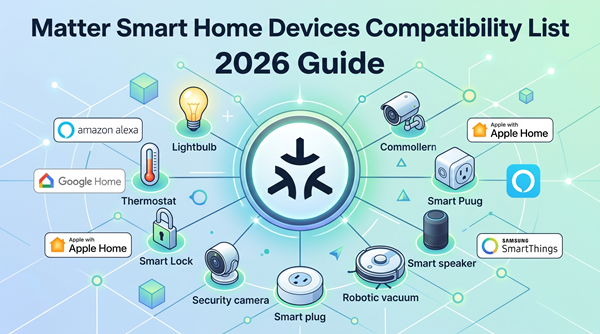
Before you buy a single sensor, you need a controller. In 2026, the 'Big Four' have fully matured their Matter implementations. You no longer have to pick one and stick to it. Thanks to the Multi-Admin feature, I can control my living room lights with my Apple Watch while my partner uses a Google Nest Hub. It is the kind of harmony we were promised a decade ago.
🏆 Our Top Picks
Eve Door & Window (Matter)
This is the gold standard for contact sensors. It uses Matter-over-Thread, meaning it responds instantly and doesn't require a proprietary bridge. It is perfect for automating lights when a door opens or checking if you left the windows open from anywhere in the world.
Check Price on Amazon →Nanoleaf Essentials Matter Smart Bulb (A19)
A budget-friendly way to flood your room with high-quality color. Since it supports Matter-over-Thread, it avoids the lag common with Bluetooth bulbs. It is the best choice for those who want to build a responsive lighting system without the high cost of Hue.
Check Price on Amazon →TP-Link Tapo P125M Matter Plug
A compact, reliable smart plug that brings 'dumb' appliances into your Matter network. It features a physical power button and a very slim profile that doesn't block the second outlet on a standard wall plate. Great for fans, lamps, and coffee makers.
Check Price on Amazon →Yale Assure Lock 2 with Matter
One of the most reliable smart locks on the market. The Matter module allows it to work across all major platforms simultaneously. While it is a bit power-hungry, the ability to manage access codes across different apps makes it a top-tier security pick.
Check Price on Amazon →Aqara Hub M3
The ultimate 'bridge' for the Matter era. It not only supports Matter-over-Thread but also brings older Aqara Zigbee sensors into your Matter ecosystem. It is the best choice for power users who want to mix old and new technology without losing functionality.
Check Price on Amazon →- Apple Home: Still the gold standard for privacy. Every HomePod and Apple TV sold in the last three years acts as a Matter Controller and a Thread Border Router.
- Google Home: Their AI integration has made Google Home the smartest of the bunch for automation logic, though the app can still feel a bit cluttered.
- Amazon Alexa: The sheer volume of Echo devices means you likely already have a Matter controller. The Echo Show 10 and 15 are particularly robust as central hubs.
- Samsung SmartThings: The dark horse that won. Their integration with appliances (fridges, washers, ovens) makes them the best choice if you want your whole house on one screen.
Lighting and Power: The Easiest Entry Point
Lighting was the first category to embrace Matter, and it remains the most reliable. We have moved past the 'basic white bulb' era. Now, we are seeing complex architectural lighting and outdoor systems that sync perfectly. In my testing, Thread-based bulbs are significantly more responsive than Wi-Fi-based ones. If you are building a list, prioritize Thread.
The Heavy Hitters in Lighting
Philips Hue remains the premium choice, though they still require their Bridge to translate Zigbee to Matter. It is a slight annoyance, but the light quality is hard to beat. On the other hand, brands like Nanoleaf and Govee have gone 'Native Matter,' meaning they connect directly to your Thread network without extra boxes. This is the direction the industry is moving. I always tell people: if you are starting fresh, go native.
Climate and Energy Management
Matter 1.4 and 1.5 brought the features we actually wanted: heat pump support and EV charger integration. In 2026, your thermostat isn't just a dial on the wall; it is the conductor of your home's energy orchestra. We are seeing devices that can talk to the grid and shift your energy usage to when it is cheapest, all via the Matter protocol.
Ecobee and Nest have finally stopped their cold war. Both now play nicely in any ecosystem. What is even more interesting is the rise of smart vents. These small devices use Matter to report room-specific temperatures back to the main thermostat, solving the 'one room is a freezer, the other is a sauna' problem that has plagued homes for years.
Security, Locks, and Access Control
This is where people get nervous, and rightfully so. You want your lock to be secure, but you also want it to open when you are carrying three bags of groceries. Matter-over-Thread locks have become the standard because they don't rely on your Wi-Fi being up. They talk directly to your hub using a low-power mesh.
Yale and Schlage have dominated this space. Their 2026 models support 'Alibi' keys and temporary Matter-based guest codes. You can generate a code in the Apple Home app, and it will automatically sync to the lock, even if the lock was originally set up in Google Home. This cross-platform code sharing is a game-changer for AirBnB hosts and families alike.
The 2026 Compatibility Matrix
To make sense of the current market, I have put together this table of the most common device categories and their Matter status as of April 2026.
| Device Category | Matter Version | Connection Type | Best Ecosystem |
|---|---|---|---|
| Smart Bulbs | 1.0+ | Thread / Wi-Fi | Universal |
| Smart Plugs | 1.0+ | Thread / Wi-Fi | Universal |
| Thermostats | 1.2+ | Wi-Fi | Google / Nest |
| Door Locks | 1.1+ | Thread | Apple / Samsung |
| Robot Vacuums | 1.2+ | Wi-Fi | Amazon / Google |
| Appliances | 1.3+ | Wi-Fi | Samsung SmartThings |
| Energy Monitors | 1.4+ | Thread | Universal |
Why Thread is the Secret Sauce
I cannot stress this enough: if you are looking at a compatibility list, look for the word 'Thread.' While Matter can run over Wi-Fi, Thread is a mesh network designed specifically for small, battery-powered devices. It doesn't clog up your Netflix streaming, and it gets stronger the more devices you add. In my experience, a home with 20 Thread devices is ten times more stable than a home with 20 Wi-Fi devices.
What most people miss is the 'Border Router.' You need at least one device that bridges your Thread network to your Wi-Fi. Most modern smart speakers (like the HomePod Mini or Echo 4th Gen) do this automatically. Once you have a Border Router, adding new Matter-over-Thread devices is as simple as scanning a QR code. It is the closest we have ever come to 'plug and play' in the tech world.
Common Pitfalls to Avoid
Even in 2026, there are traps. First, beware of 'Matter-Compatible' vs. 'Native Matter.' Some older devices use a bridge to talk to Matter. While this works, it adds a point of failure. If the bridge dies, your whole system goes dark. Always aim for native support when buying new gear.
Second, don't ignore your router. Even though Thread handles the small stuff, your Matter Controllers still need a rock-solid Wi-Fi connection. I have seen countless people blame Matter for 'No Response' errors when the real culprit was a cheap ISP-provided router that couldn't handle 50 simultaneous connections. If you are going all-in on a smart home, invest in a decent mesh Wi-Fi system first.
The Future: Ambient Intelligence
As we look toward the rest of 2026 and into 2027, the conversation is shifting from 'Does it work?' to 'What can it do?' We are seeing the rise of ambient sensing. Matter-enabled presence sensors can now detect your breathing rate and sleep patterns without cameras. This data can then trigger your HVAC or lighting. The compatibility list is no longer just about hardware; it is about the data these devices can share to make your life easier without you ever touching a button.
Frequently Asked Questions
Do I need to replace my old Zigbee or Z-Wave devices?
Not necessarily. Many hubs, like the Aqara M3 or Samsung SmartThings Station, act as bridges that bring your existing Zigbee devices into your Matter ecosystem seamlessly.
Can I control Matter devices when the internet is down?
Yes. One of the core benefits of Matter is local control. As long as your internal home network (Wi-Fi and Thread) is running, your automations and switches will continue to work without an internet connection.
What is the difference between Matter and Thread?
Matter is the language devices speak (the protocol), while Thread is the road they travel on (the wireless mesh network). Matter can also travel over Wi-Fi or Ethernet, but Thread is preferred for low-power devices.